Curly pixie haircuts can be a beautiful choice for round faces because they combine natural texture with a short, defined silhouette. The right shape can create height, movement, and gentle angles without losing the softness that makes curls so appealing.
A well-cut curly pixie does not need to make the face look dramatically different. Instead, thoughtful volume placement, tapered sides, longer top layers, and side-swept details can create a balanced appearance. Whether your curls are tight, loose, or somewhere between, these styles offer plenty of ways to personalize a short haircut.
Curly Pixie Shapes That Create Beautiful Balance
When choosing a curly pixie for a round face, consider where the haircut creates its volume. Height through the crown can add vertical movement, while slightly tapered sides help prevent excessive width around the cheeks.
Longer curls toward the top and diagonal fringe can also create attractive lines across the face. The best shape depends on your curl pattern, density, and styling routine, so the haircut should be customized rather than treated as a one-size-fits-all formula.
Curly Pixie with Crown Height
A curly pixie with extra height through the crown creates vertical movement that can beautifully complement rounded facial proportions. The lifted curls draw attention upward while the shorter sides keep the silhouette controlled.
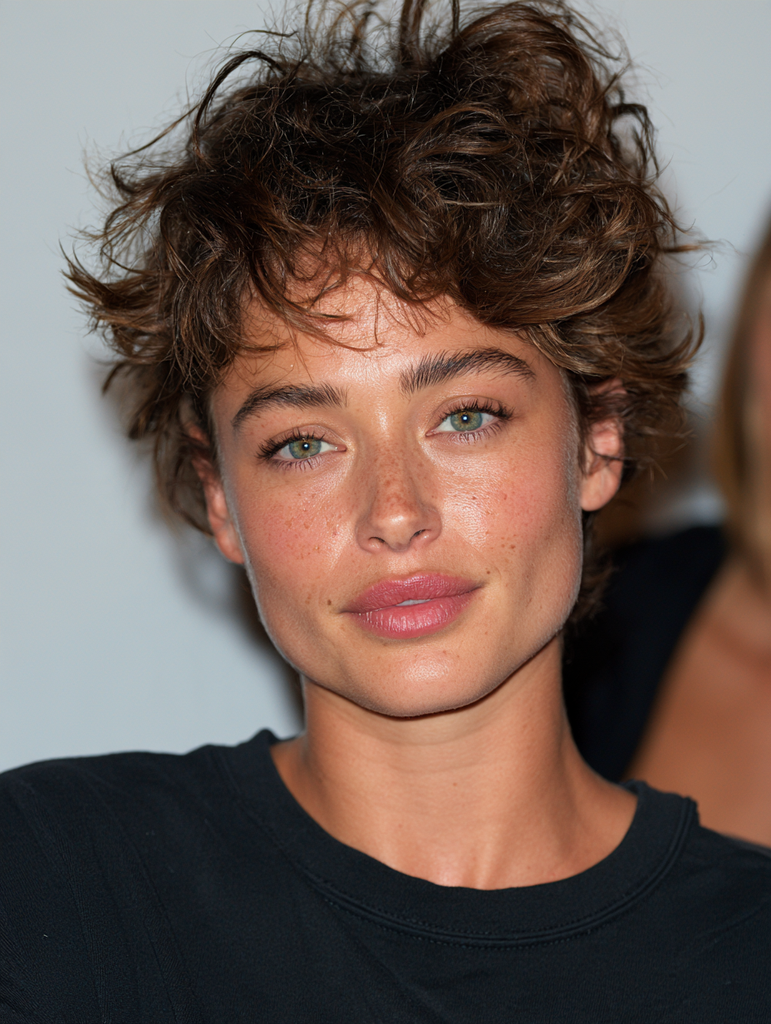
Leave enough length on top for your curls to form naturally rather than cutting them extremely short. Keep the sides tapered gradually and encourage the crown curls upward with lightweight styling cream. This creates a lively, dimensional hairstyle that feels modern while still allowing your natural texture to remain the star.
Side-Swept Curly Pixie
A side-swept curly pixie introduces an attractive diagonal line across the forehead while allowing natural curls to create softness. The asymmetrical direction gives the short haircut a more elongated visual flow.

Keep the fringe slightly longer so the curls can sweep naturally toward one side. The opposite side can be tapered closer to the head for contrast. Apply curl cream to damp hair and gently shape the curls with your fingers, preserving their definition without making the style appear stiff or overly controlled.
Tapered Curly Pixie with Long Top
A tapered curly pixie keeps the sides and nape neat while leaving substantial length through the top. This contrast creates height and movement without adding unnecessary fullness around the cheeks.

Ask for a gradual taper rather than an extremely close cut if you prefer a softer appearance. The longer curls can be shaped upward and slightly forward for dimension. A lightweight curl-defining product can enhance the natural pattern while keeping the top bouncy, touchable, and easy to refresh.
Layered Curly Pixie
A layered curly pixie distributes the curls throughout the haircut while creating a lighter, more dimensional shape. Strategic layers prevent the curls from forming one rounded mass around the head.

Keep the crown slightly longer than the sides and allow the layers to blend naturally. The curls should retain enough length to form distinct shapes rather than becoming overly tight and compact. Use a moisturizing curl cream and gently scrunch the hair, allowing it to dry naturally or with a diffuser.
Curly Pixie Bob
A curly pixie bob provides slightly more length around the front and sides while maintaining the convenience of a short haircut. The extra length gives curls room to frame the face softly.

Keep the front sections around the cheekbone or slightly below, depending on your curl pattern and shrinkage. The back can remain shorter for a neat silhouette. This style works especially well when you want the playful character of a pixie without committing to an extremely cropped shape.
Voluminous Curly Pixie with Side Part
A side part changes the direction of the curls while creating additional height near the crown. The asymmetrical arrangement helps keep the hairstyle from forming a completely rounded outline.

Allow the heavier side to retain more curl volume while keeping the opposite section slightly closer to the head. Use your fingers to define individual curls rather than brushing them. A lightweight mousse can provide additional hold while preserving the natural bounce and softness of the texture.
Short Curly Pixie with Wispy Fringe
A wispy fringe adds softness across the forehead without creating a heavy horizontal line. Combined with a short curly pixie, it produces a lightweight style with plenty of personality.

Keep the fringe slightly uneven and allow a few curls to fall naturally toward the forehead. The sides can be gently tapered while the crown remains textured. This haircut is particularly appealing for anyone who wants a low-maintenance shape that still feels feminine, playful, and naturally dimensional.
Curly Pixie with Undercut Sides
An undercut curly pixie creates a dramatic contrast between closely cropped sides and a fuller, textured top. The reduced side volume allows the curls on top to become the main focus.

Keep the top long enough to create height and movement rather than flattening the curls against the head. The undercut can remain subtle or become more pronounced depending on your preferred style. Define the curls with a moisturizing product and gently direct them upward for a striking finish.
Soft Curly Pixie with Face-Framing Curls
A soft curly pixie uses longer curls around the temples and forehead to create gentle framing. These pieces soften the transition between the hairstyle and facial features while maintaining a short overall length.

Keep the surrounding curls lightweight rather than allowing them to become overly bulky around the cheeks. The crown can have moderate lift for additional vertical movement. Apply curl cream while the hair is damp, then shape individual curls with your fingers for a soft, touchable finish.
Curly Pixie with Textured Crown
A textured crown gives a curly pixie extra dimension and creates a subtle upward direction. The result can make the hairstyle appear taller while keeping the sides relatively controlled.

Ask for enough length through the crown to separate the curls without losing their natural pattern. Use a small amount of styling paste or curl cream to define selected pieces. Avoid flattening the roots, as natural lift through the top helps maintain the haircut’s balanced silhouette.
Asymmetrical Curly Pixie
An asymmetrical curly pixie uses uneven lengths to create a distinctive diagonal silhouette. One side can retain longer curls while the opposite side remains shorter and more tapered.

The difference in length adds visual movement and keeps the hairstyle from forming a uniform rounded shape. Let the longer curls fall toward the cheekbone while keeping the shorter side neat. This style works especially well for anyone who wants a curly pixie with a more fashion-forward and personalized finish.
Curly Pixie with Feathered Side Layers
Feathered side layers create movement around the temples while keeping the crown and top relatively lifted. The soft texture prevents the haircut from appearing overly geometric.

Ask for gradual layering that follows the natural curl pattern rather than creating abrupt steps. Leave enough length around the sides for the curls to move freely. A lightweight leave-in conditioner can help maintain softness, while curl cream adds definition without weighing down the shorter sections.
Easy Ways to Style a Curly Pixie
Start with damp hair and apply a lightweight curl cream or mousse, distributing it evenly without disturbing the natural pattern. Scrunch the curls upward, then allow them to air-dry or use a diffuser on a gentle setting.
For extra height, lift the roots at the crown while drying and direct the curls upward with your fingers. Avoid brushing dry curls, as this can disrupt definition and create unnecessary frizz. Refresh the style on following days with a little water and curl-enhancing product.
Finding the Right Curly Pixie for Your Texture
Your curl pattern should play a major role in deciding the final length and layering. Tighter curls may require additional length to prevent excessive shrinkage, while looser curls can often support shorter layers.
Hair density matters as well. Thick curls may benefit from carefully controlled shaping, while finer curls can use strategic crown layers to create dimension. Rather than focusing only on face shape, choose a pixie that works with your natural texture and fits the amount of styling you want to do each day.
